Could you tell us a little about yourself and how you became a deminer?
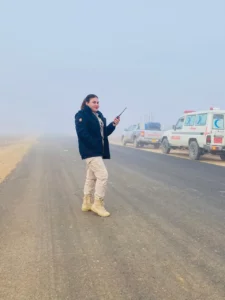
My name is Sana Khalaf and I come from the district of Sinjar. I am a university graduate with a bachelor's degree. I joined the clearance sector in 2020. I started as a community liaison officer with a local NGO. That role really made me want to embrace the idea of clearance operations to support people in danger. I understand how important it is to remove the risks from our community. As a young woman, I see an opportunity to contribute to my community in Sinjar and I want to prove that I can play a positive part in improving safety. I also want to be a role model for young women, by showing that we can have a real impact.
How did you come to be involved in the Safer Sinjar project run jointly by HAMAP-Humanitaire and SHO?
I first saw an advertisement for the post, I applied, I was interviewed and I was happy to be accepted. HAMAP-Humanitaire and Saferworld Humanitarian Organization gave everyone an equal chance to take part in the project. The fair process meant everyone had an opportunity to be involved.
How do you balance your family responsibilities with the demanding work of a deminer?
It is not easy to find a balance, but I can count on my husband's support. His encouragement and his belief in my work matter a great deal to me. He not only backs my decision to keep working, he also expresses his pride at family gatherings when he talks about my commitment to the safety of our community in Sinjar.
What does a typical day look like for you?
In summer I wake at 3.30 in the morning, go out to the field with the team and stay there until 1pm. The heat is intense and exhausting, but it is part of the job. Then I go home to take care of household tasks such as cleaning, cooking and receiving guests.
Despite the challenges, working in the field gives a strong sense of solidarity. We support one another and stay in touch even outside working hours.
How did your family and your community react at first?
Most people are surprised and react with admiration when they see how I handle this difficult work. The field is often seen as male-dominated. My mother, for instance, worries about my safety every day.
Together with my female colleagues, we show that women can carry out demanding tasks. We want to demonstrate that safety is a collective responsibility and that no one should be left on the margins.
What are the challenges of being a woman in this field?
It is not necessarily experienced as a major challenge, but it does affect our daily lives. Our schedule, for example, sometimes limits our ability to take part in social or family events. We have to organise our activities carefully.
How have social norms shaped your path?
In some social attitudes, women are expected to stay at home while men provide the income. That can influence how female deminers are seen.
Despite this, my husband's support is essential. He encourages me by saying: “Use other people's doubts as a ladder to lift yourself up.” That helps me overcome social obstacles.
Building internal capacity
What training have you taken?
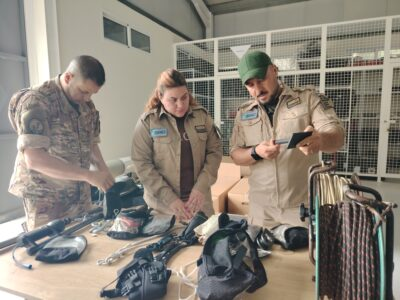
I took part in four long-term training sessions with SHO and HAMAP-Humanitaire. I also took first aid training and refresher sessions, particularly on:
- identifying munitions
- advanced search in high-risk areas
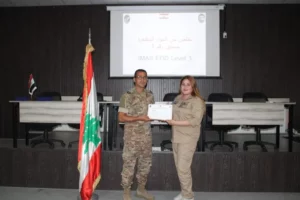
This training also prepared me for advanced EOD level 3 training in Lebanon.
How did this training help you?
At the start, my knowledge was limited. Thanks to the training, my understanding of mine action improved considerably. The emphasis on safety is fundamental: working effectively while guaranteeing safety is an absolute priority.
Advanced EOD level 3 training
How were you selected?
My enthusiasm and commitment from the outset played a key part. I sought to keep learning by asking my supervisors questions and by developing my skills in the field. That contributed to my selection.
What was the training in Lebanon like?
It was the first time I had lived away from my family, which was hard at first. But learning every day and the guidance of the trainers helped me adapt. I was also made very welcome by local people.
What skills did you gain?
- Calculating safety distances
- Classifying explosives
- Observing live explosives
- Managing a demolition process
How will you use these skills?
I want to share what I have learned with my colleagues. If I become a team leader, I will apply the methods I learned and help improve practice in the field.
Memorable experiences in Lebanon
Two experiences stood out during my stay:
- The warm welcome of a landlord who offered us food as soon as we arrived
- The spontaneous help of a driver who took us to Beirut free of charge
These experiences illustrate human solidarity and generosity.
Professional learning
What have you learned from your colleagues?
I learned the importance of teamwork and of how the skills of experienced professionals and newcomers complement one another. The exchanges also allowed us to compare humanitarian and military approaches.
How is knowledge shared?
We talk openly about our experiences and our specialisms. That allows mutual learning and strengthens our understanding of safety procedures.
The role of HAMAP technical advisers
The technical advisers played a key part in preparing us beforehand, providing:
- theoretical information
- practical guidance
- reporting instructions
This preparation meant we took in the knowledge better and passed the assessments.
A wider view of safety
My goal is for children to be able to go to school or play without danger. Clearance work also helps:
- make access to water and electricity easier
- allow farmers to work their land
- support families' livelihoods
I also want to strengthen women's empowerment by creating a safer environment for them and their children.
Future aspirations
I want to keep working in this field to help keep people safe, particularly in regions affected by conflict. I also want to pass on my knowledge and take part in building local capacity.
Closing thoughts
I want to express my gratitude to HAMAP-Humanitaire for its support. The help provided, and in particular allowing my husband to accompany me, strengthened my confidence and my sense of safety.
Advice to women
Women are capable of the same tasks as men. It is important to believe in your own abilities, not to be swayed by social judgements, and to contribute actively to the safety of the community.
Impact and outlook
I want to inspire other women to get involved and to take part in rebuilding their community. Women play an essential role for future generations, and their involvement will have a lasting impact.
The change we would like to see in society
It is important to narrow the gaps between men and women in non-traditional fields. Encouraging women to take an active part in the development of society is essential for the future.