WASH context
LAOSSupport for rural communities on access to water and sanitation
Laos has abundant water resources. The climate is shaped by the monsoon, with rainfall of 1,800 mm a year. Most of the country lies in the Mekong basin. Groundwater is also plentiful.
Urbanisation, economic development and farming, particularly in the mountains, threaten the water resource.
Read more about the context
In Laos, access to drinking water and sanitation has improved over recent decades, but wide gaps remain between urban and rural areas.
In the towns, most of the population has relatively reliable access to treated water and improved sanitation facilities.
In rural Laos, by contrast, access to drinking water and sanitation remains a significant challenge.
Many villages, particularly in mountainous and remote regions, still depend on rivers, natural springs or wells whose water quality is not always assured.
During the dry season, some communities can also face water shortages.
On sanitation, although the situation has improved, some families still have no adequate toilet and open defecation rates remain high.
These conditions increase the risk of waterborne diseases such as diarrhoea, and affect children in particular.
These inequalities are a major challenge for the country's development and public health.
HAMAP has been working since 2024 in the Nam Ngum basin, as part of the institutional cooperation between the Rhin-Meuse and Loire-Bretagne water agencies and the Department of Agriculture and Environment of Vientiane Province.
Our work
ACTING FOR WATER
IN LAOS
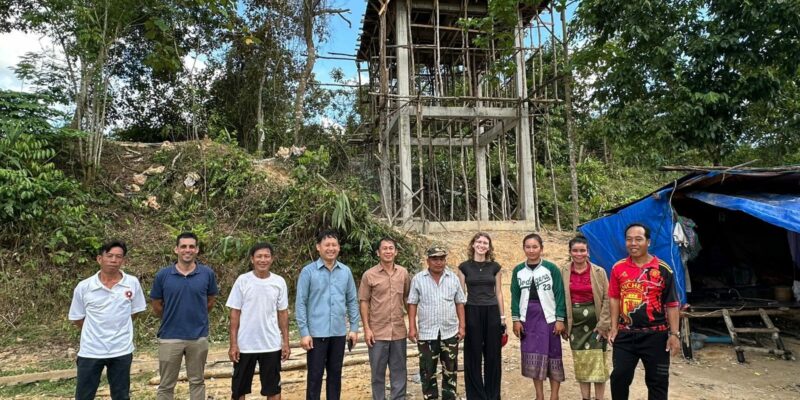
HAMAP works in the districts of Feuang and Kasi through water, sanitation and hygiene projects.
The approach rests on involving people directly in running the water facilities: village water management committees are set up and keep a close relationship with residents.
Communities take an active part in the construction works, private connections and family latrines, which strengthens local ownership and the durability of the project.
Our projects
WATER AND SANITATION
IN LAOS1 project carried out since 2024
Funding partners
THEY SUPPORT OUR WORK IN LAOS

SUPPORT ACCESS
TO WATER IN LAOS
Since 2024, more than 2,000 people have benefited from our work on access to water and sanitation.
Donate